It’s Not Like That season 1, episode 2 review: The Wonder Project show builds on its success

SPOILER ALERT AND WARNING: The following contains spoilers for It’s Not Like That Season 1, Episode 2. It also contains discussion of self-harm.
The second episode of It’s Not Like That does what it needs to do: further flesh out the characters and themes beyond the blueprint laid out in the series premiere. “New Voices” is aptly titled, as in discussing the theme of change, the Wonder Project show illustrates how each of its main characters is going to change.
Notably, the episode does not focus on the fallout from the kiss between Malcolm Jeffries and Lori Soto. Although that is definitely part of Episode 2’s story, It’s Not Like That remains impressively balanced, as their children actually have the most important storylines here. One of the less effective plots from the first episode, the “mean girl” problem wedging between Casey and Pen, works better in Episode 2 as part of a larger plot. Pen’s younger brother Justin is physically assaulted by another student, but she doesn’t do anything about it, leading Casey to come to Justin’s rescue. The incident not only further illustrates the gulf between the two former friends, but it opens up a subplot for Pen and Justin, as she has to explain to her brother why she didn’t help when he needed her. What started as a predictable story now carries more dramatic weight.
Elsewhere, audiences learn about Pen and Justin’s sister Flora as she continues to look for her own voice. “New Voices” explains why Flora is in therapy: she had a previous incident of self-harm. It’s refreshing to see a series address this subject, and to do so without any judgment. It’s easy when writing teenage characters to fall into melodrama, but this exploration of Flora feels real—both in the hard parts and in how Flora becomes inspired to move forward.
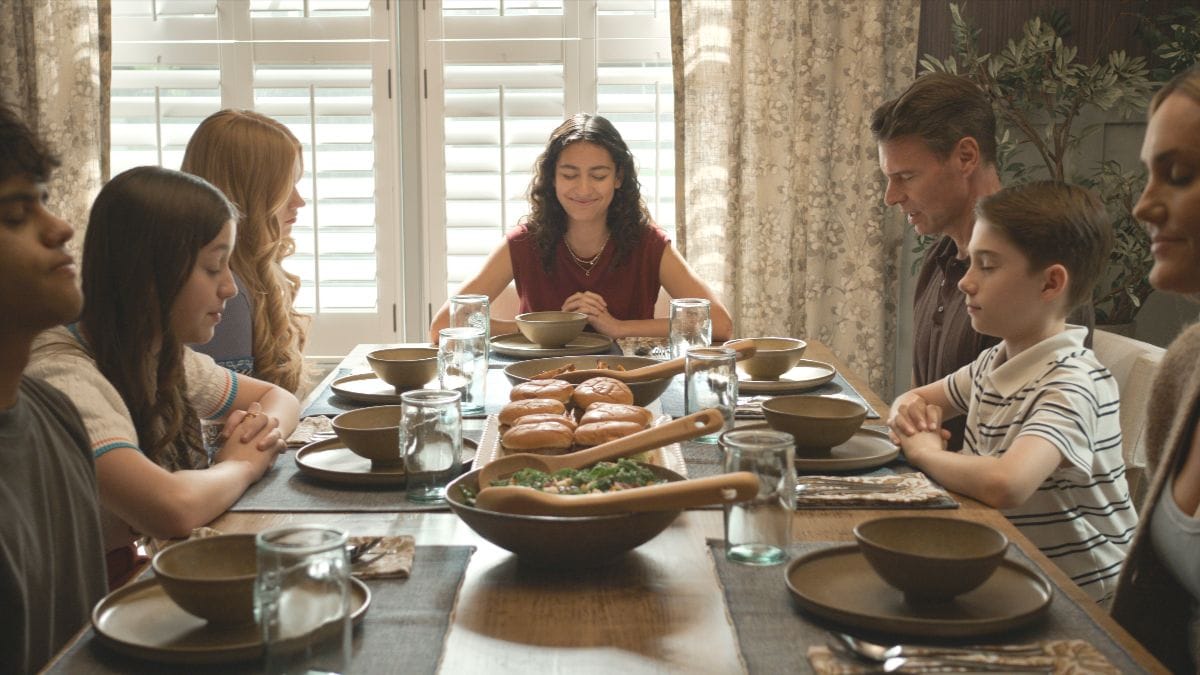
“New Voices” also includes Lori’s first date with Joe, the man she met on the dating app, while struggling to articulate that David “is not the bad guy” to her children. It’s Not Like That has taken pains to present all of its adult characters as fully rounded individuals. One can’t fault Casey and Merritt, because they have a valid point that David initiated the end of their family for reasons that even he doesn’t totally understand. But neither Lori nor the show as a whole writes him off. Everyone has a seat at the proverbial table, even as viewers can guess that Joe is not going to be the miracle man to sweep Lori off her feet (because that would be a short-lived character arc for her). Even the flashback scenes with Jenny don’t paint her in an idealized way; she seems like a great person, but she’s not put up on any kind of pedestal.
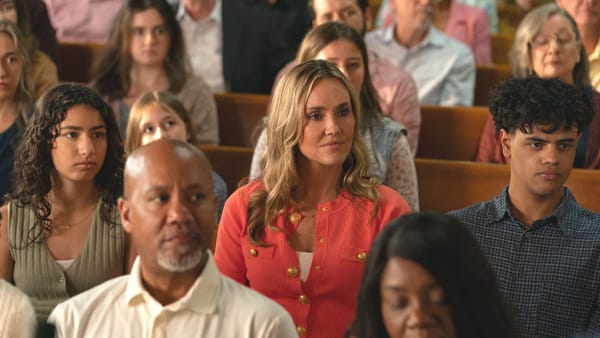
Something else that is less prominent in the episode but very much worth talking about is the interfaith element of the series. The church continues to have its own subplot, as Malcolm realizes that contrary to the end of Episode 1, not everyone appreciated his openness. But one of the best scenes is when he’s speaking to his friends, who are two of the other religious leaders in their community. It’s Not Like That is having a wonderful discussion about faith and belief, but it’s not just focusing on Malcolm’s church or his belief system. Just as Flora has been given the space to step away from church, the show is making a point of including other faiths. That also adds further to the sense of community that creators Ian Deitchman and Kristin Robinson are trying to build.
When “New Voices” does get around to Malcolm and Lori’s kiss, in two separate but equally important scenes, it feels like an afterthought. Not because their discussion isn’t important, but because everything else going on is so well-developed that neither they nor the show are defined by this “will they, won’t they.” Lori and Malcolm have different opinions on the moment, and each is able to state their case. Neither is necessarily wrong. (In fact, it’s kind of funny how both end up blurting out that they kissed while talking to other people who didn’t need to know this information.) Robinson and Deitchman have to come up with a believable way to keep them apart, because the audience knows that has to happen; the show isn’t going to contradict its title in the second episode. They clear that hurdle by just being honest. There are plenty of logistical reasons why these two can’t work, and one big emotional reason why they should.
Episode 2 doesn’t make any major leaps and bounds plot-wise. It’s more laying the groundwork, building on what Episode 1 started and pointing the audience toward what’s coming in the remainder of the season. But even so, it adds details that make the characters more intriguing. There isn’t any drama for drama’s sake, or dragging out any emotion to keep the audience on the hook. “New Voices” simply lets the viewers get to know the characters better. A pre-credits screen providing mental health resources is also a welcome touch that shows the creative team cares about what they’re saying, beyond just entertainment value. This show is quickly developing into the next great family drama.
It’s Not Like That streams Sundays on Wonder Project on Prime Video. Photo Credit: Steve Dietl/Courtesy of Amazon MGM Studios.
Article content is (c)2020-2026 Brittany Frederick and may not be excerpted or reproduced without express written permission by the author. Follow me on Twitter at @BFTVTwtr and on Instagram at @BFTVGram. For story pitches, contact me at tvbrittanyf@yahoo.com.